

Science is a search for evidence, but science communication is a search for meaning.
Storytelling makes science meaningful.

Studies show that storytelling helps people to absorb, recall, and connect with new information. Just as important, distilling complex subjects into engaging stories is an effective way to build trust—one of the most crucial objectives for scientists. Many institutions now encourage using storytelling to communicate science. However, few resources offer practical training on how to translate technical content into compelling stories.
In search of better ways to communicate my own scientific research, I began collaborating with industry artists to learn how to craft compelling stories. This inspired me to design content and experiences to help practitioners engage any audience with complex subjects through effective and meaningful storytelling. I have been offering this training through interactive workshops, coaching, and presentations for over a decade.

Sara ElShafie discusses science storytelling with participants at a workshop held for the Society for Integrative and Comparative Biology Annual Meeting in San Francisco, CA, January 2018. Photo courtesy of Helina Chin.
My clients gain:
Practical tools to improve any form of communication.
Bespoke interactive experiences, presentations, and related material.
Preparation to collaborate effectively with other communicators (e.g., media, artists, marketers).
Whether you need to capture an audience with a compelling story, or communicate technical details in a more engaging way, the same basic tools and core principles apply. I can help you learn these tools and apply them effectively for any communication need, context or format.
Let’s make science meaningful together!
Welcome message from Dr. Sara ElShafie, Founder & Principal, Science Through Story, LLC
“Sara is a pioneer in scaling meaningful science communication. By harnessing the power of storytelling… she is helping science communicators tap into resources and techniques that few have ever considered.”
“This workshop was truly inspirational and beyond helpful. It was the first time in three years that I felt like I was finally finding the human and relatable point of view for my science story.”

A workshop held for the Western Society of Naturalists in Monterey, CA, in November 2016. Photo courtesy of Jennifer Hofmeister.
“Thank you for showing us the foundations of storytelling... There was clear depth to your knowledge and skills, and you shared them in a way that was very useful and thought-provoking. I really appreciated the opportunities to practice and play around with the ideas you presented to make them more relatable and memorable afterwards.”
Selected past Clients






Want to get updates on workshops and events available to the public?
What’s New
Wondering how to use/not use AI when applying for jobs?
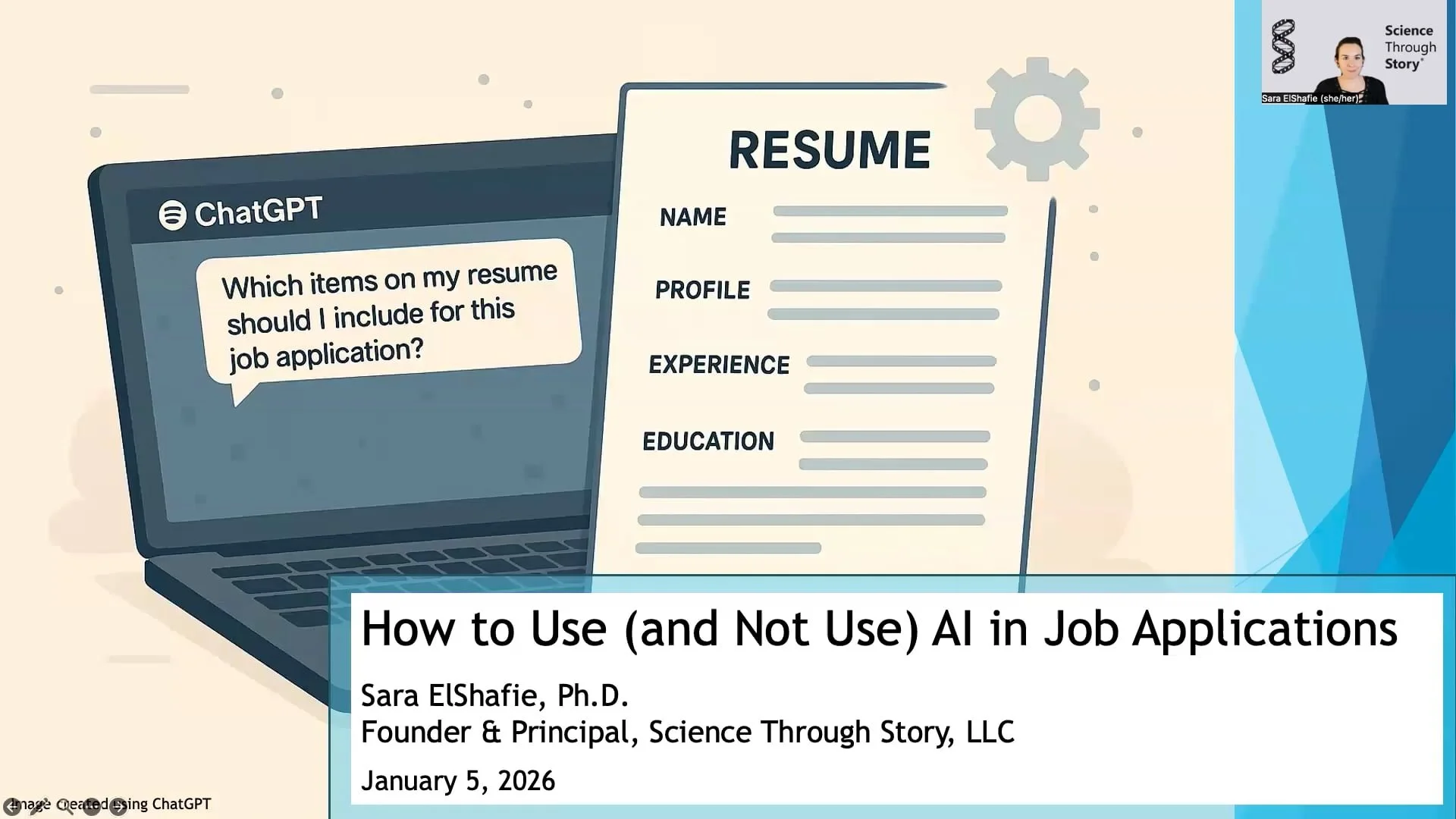
This recorded presentation from a recent workshop can help you get started!
Want to learn about careers and transferable skills in STEM?
Watch my guest interview on the YouTube show Dr. Neurosaurus!
How can we use storytelling in technical writing?

If you’re interested in reptiles, body size evolution, or storytelling in the form of a scientific paper, you can check out my new publication in the peer-reviewed journal PLOS ONE - open access (no charge)!